Lisbon, Two Buildings, and a Conversation in Ceramic Tiles
Have you ever travelled specifically for a building? Not for a city, not for a culture, not for the food or the wine or the warm Atlantic evenings, but because a particular piece of architecture demanded your presence, your camera, and your full professional attention?
Watch the video HERE
That's precisely what brought me to Lisbon in early 2026. Two buildings. Both remarkable. Both recent. Both, (and this is the detail that made the trip irresistible) using the same material in ways that feel like an architectural conversation happening across the same city, at the same moment in time.
One of them turns ten years old this year. The other has barely been open eighteen months. Together, they've convinced me that Lisbon is doing something no other European city is currently managing: producing world-class contemporary architecture that feels genuinely rooted in its place.
MAAT: The Building That Became a Landscape
The Museum of Art, Architecture and Technology sits on the north bank of the Tagus, just west of Belém, and it announces itself from some distance. Amanda Levete's design — completed in 2016 for EDP, the Portuguese energy company, is clad entirely in three-dimensional ceramic tiles that shift from pure white to almost luminous cream depending on the angle of the light and the hour of the day. From the river, it reads as a single, undulating form. Organic. Inevitable. As if it grew from the riverbank rather than being placed upon it.
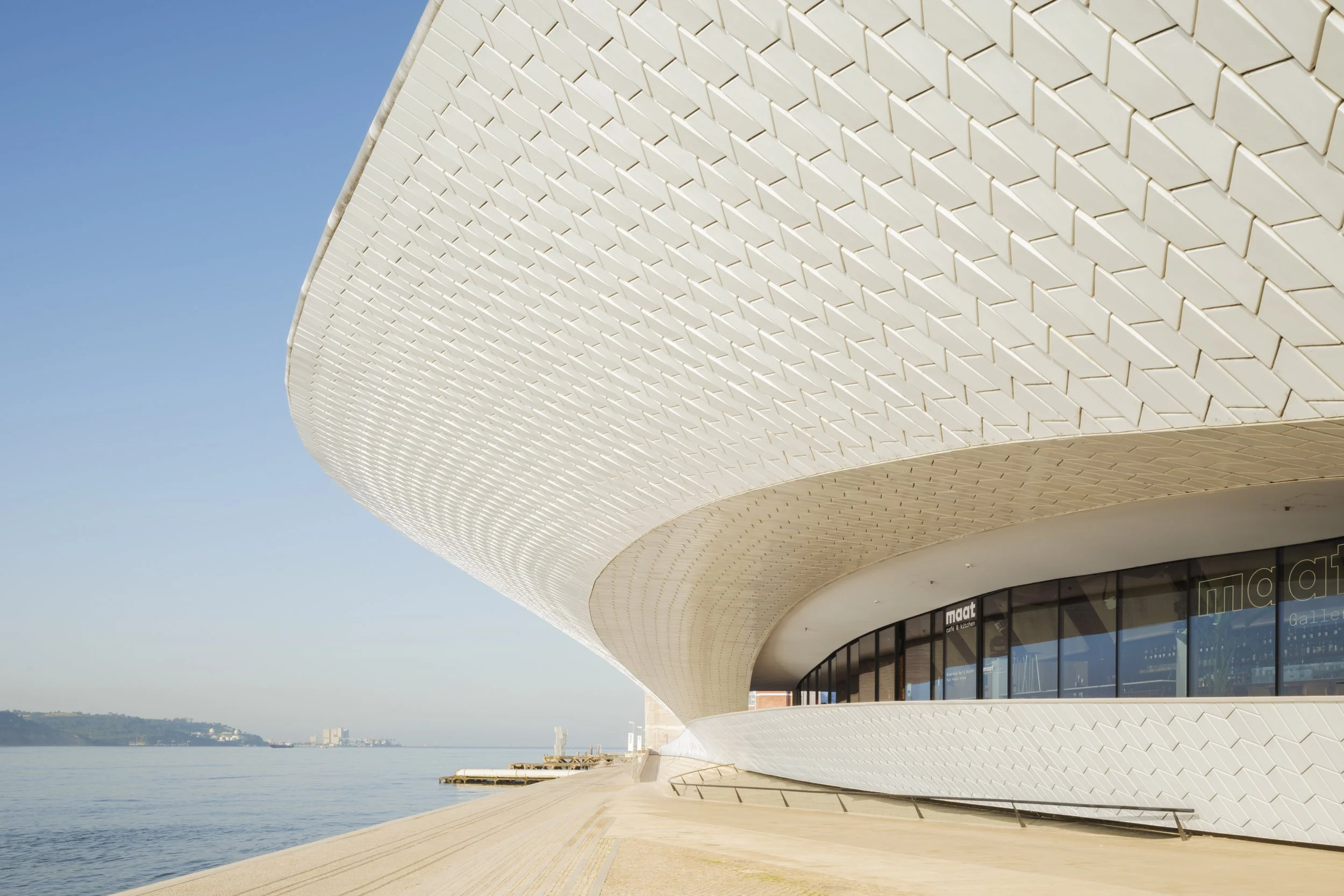
Museum of Art, Architecture & Technology - MAAT in Lisbon
What separates MAAT from most contemporary museum buildings is the roof. Levete made it walkable — you climb from the riverside promenade, cross the full length of the building above your head, and arrive back at ground level on the other side, with the 25 de Abril Bridge filling the view the entire way. It’s a genuinely strange and generous thing to do with a museum roof. The building stops being an object you look at and becomes a place you move through. It doesn’t end at its walls. It extends into the city.
Ten years on from its opening, that ambition has been fully vindicated. MAAT isn't just part of Lisbon's skyline now — it feels like it always was.
The Photographic Challenge: No Straight Lines
I'll be direct with you: MAAT is one of the most technically demanding buildings I've photographed. The entire facade is a continuous curve. There are no straight lines, no right angles, no convenient architectural grammar to hang a composition on. Every decision — lens choice, position, time of day — produces a fundamentally different building.
I spent the better part of two days working around the exterior, chasing shadow lines. The three-dimensional tile surface, which looks deceptively flat in some photographs, reveals itself as deeply sculpted when the sun catches it at a low angle. It's in those moments, when a single shadow edge bisects the facade diagonally, that the building really sings. You're not composing, you're waiting. Reading the light, understanding when the building wants to be photographed, and having the patience to be there when it does.
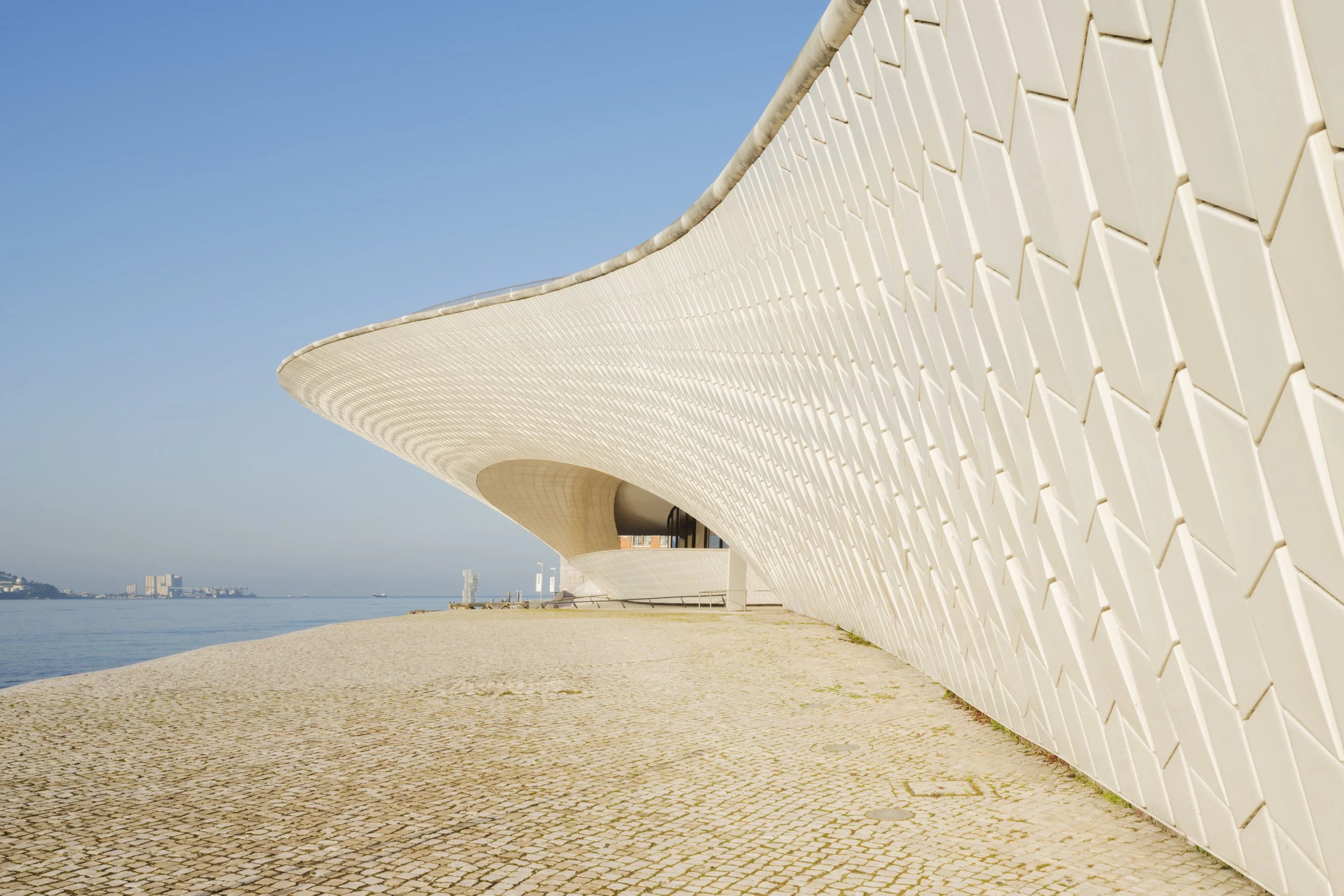
Individual Portuguese ceramic tiles cover the facade of MAAT
The challenge of horizontals and verticals deserves a word too. With no straight architectural lines to reference, I relied entirely on my tripod's levelling bubbles and the artificial 3D horizon built into my camera's live view. Small details, but crucial ones — the sort of technical discipline that separates a photograph of a building from an architectural photograph.
The Rooftop
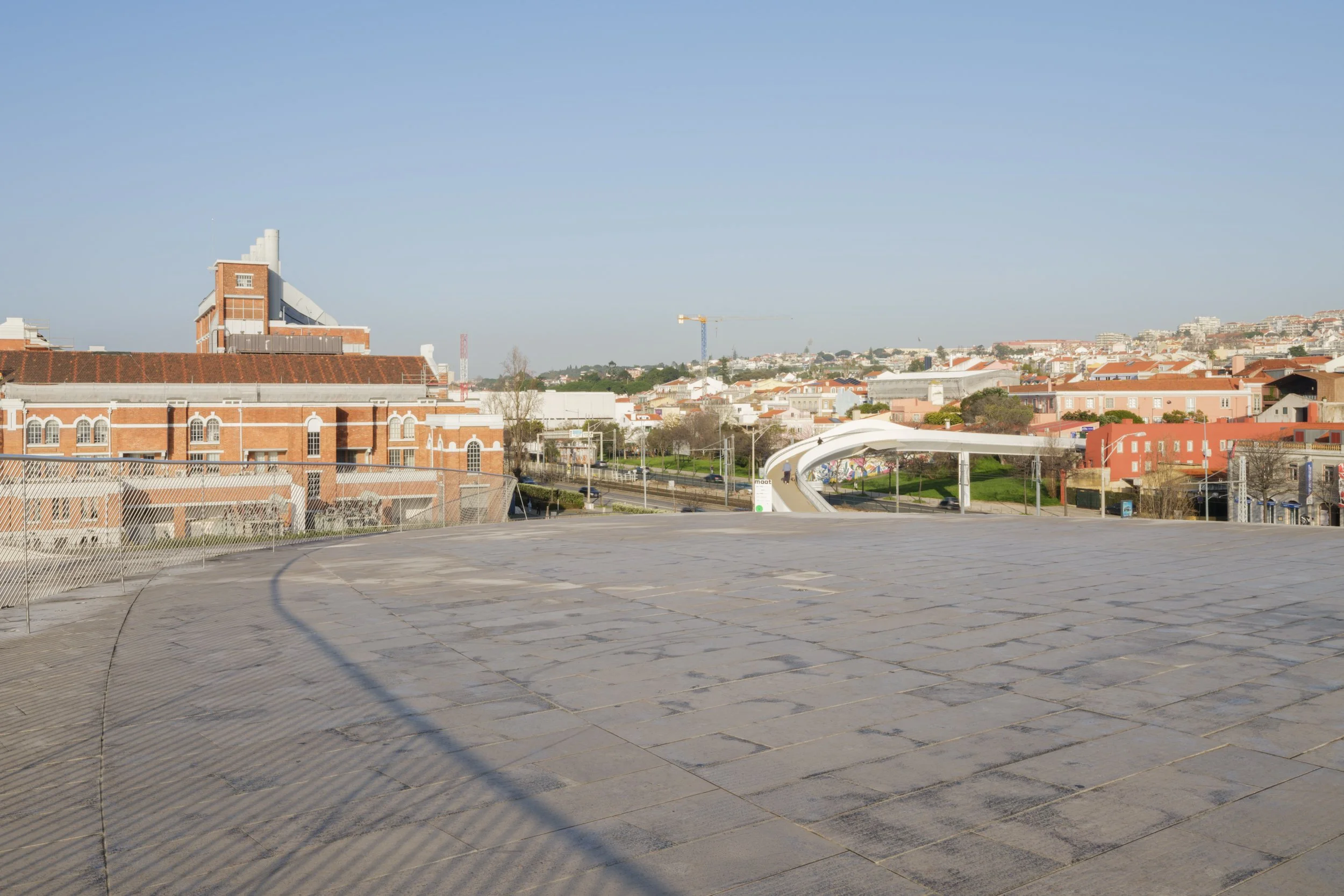
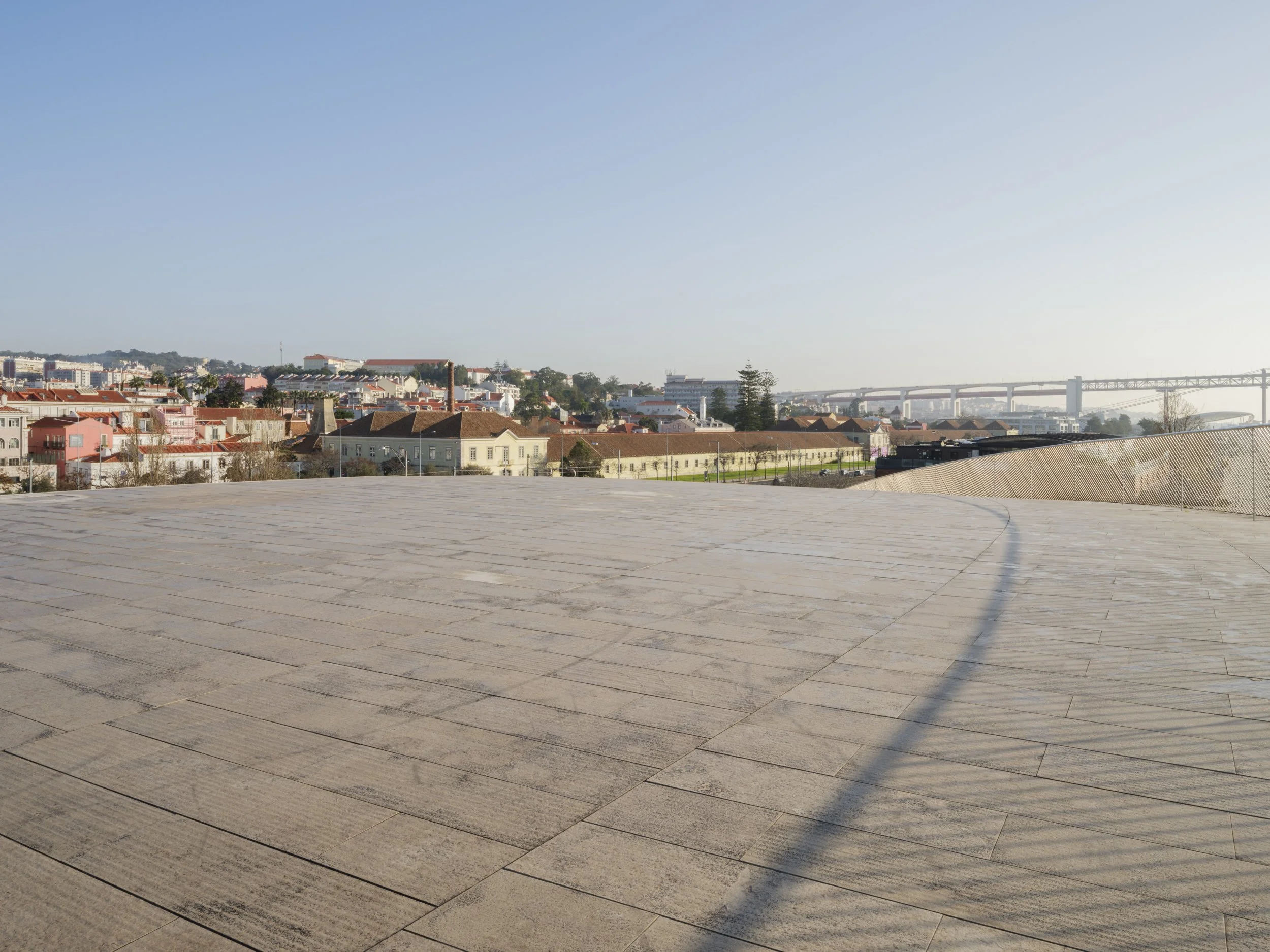
Get up there as early as you can. Before the visitors arrive, the rooftop walkway offers one of the most genuinely surprising views in Lisbon — the 25 de Abril Bridge framed against the river, the Tagus impossibly wide in the morning light, and the roofline of the building itself curving down toward the waterline in a gesture that still feels radical a decade after it was built.
From up here, you understand what Levete was actually proposing. Not a museum with a nice roof terrace, a public act. Architecture as civic generosity.
CAM Gulbenkian: Forty Minutes and a Different Philosophy
Forty minutes across the city by public transport. Eighteen acres of mature woodland. And a building that opened in the autumn of 2024, which means that most people, even those who follow contemporary architecture closely, haven't seen it properly yet.
The Centro de Arte Moderna Gulbenkian was founded in 1983 in the grounds of the Calouste Gulbenkian Foundation, itself one of Lisbon's great cultural institutions. The renovation and expansion completed by the Japanese architect Kengo Kuma is his first built project in Portugal, and it announces itself so quietly you could almost miss it.
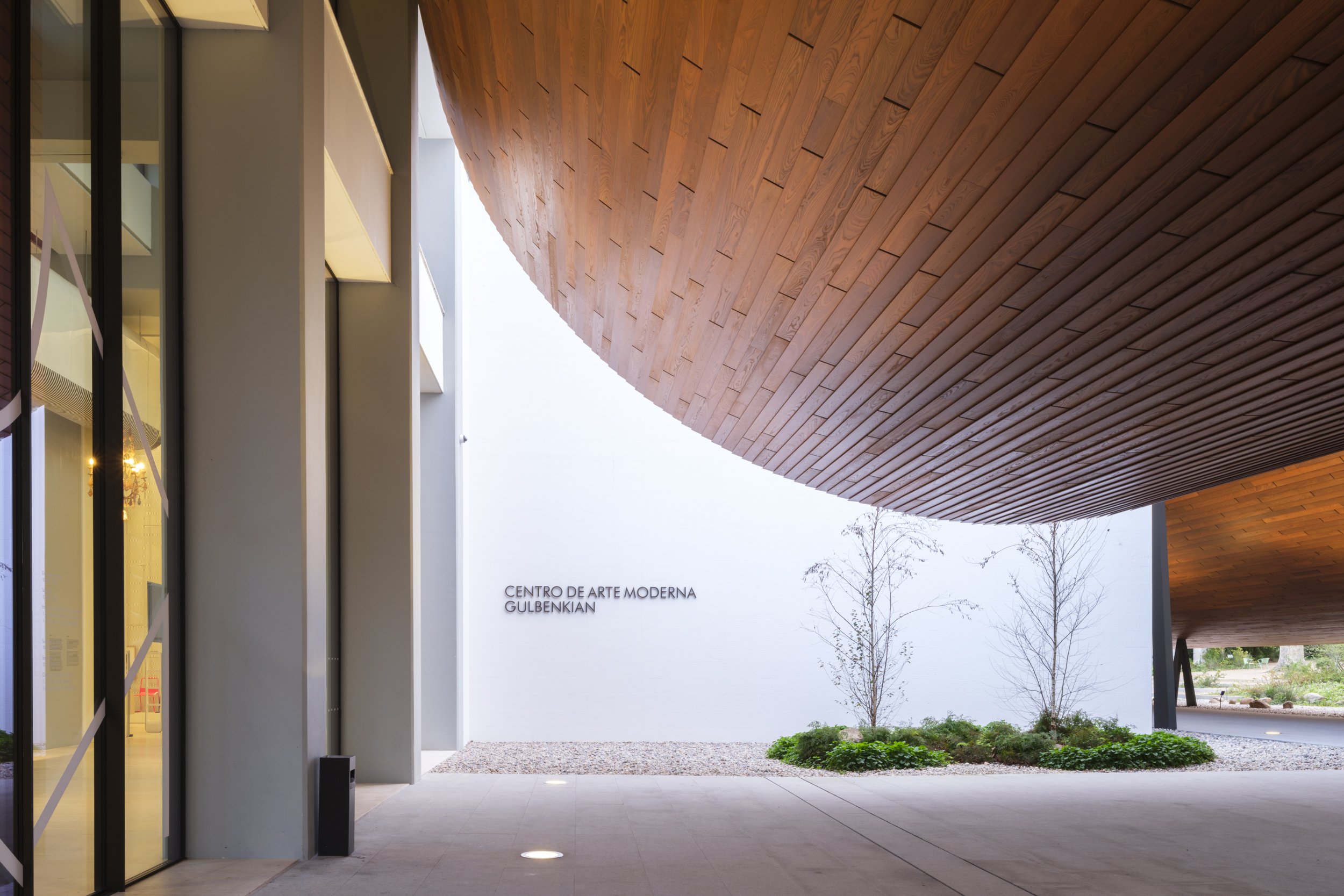
CAM Gulbenkian Lisbon
Almost. But not quite.
The Engawa
The defining element of Kuma’s intervention is what he calls the Engawa — a term drawn from traditional Japanese architecture, where the engawa is a transitional space at the edge of a building. Not inside, not outside. A threshold. The place where the building pauses before it meets the world.
Kuma has taken that concept and stretched it into a hundred-metre canopy that runs the full length of the building. At the garden edge, it hovers at roughly two metres. By the time it reaches the main facade, it has risen to ten. Walk the length of it and you experience the building changing around you, the compression of the low entry, the gradual expansion into something vast and cathedral-like.
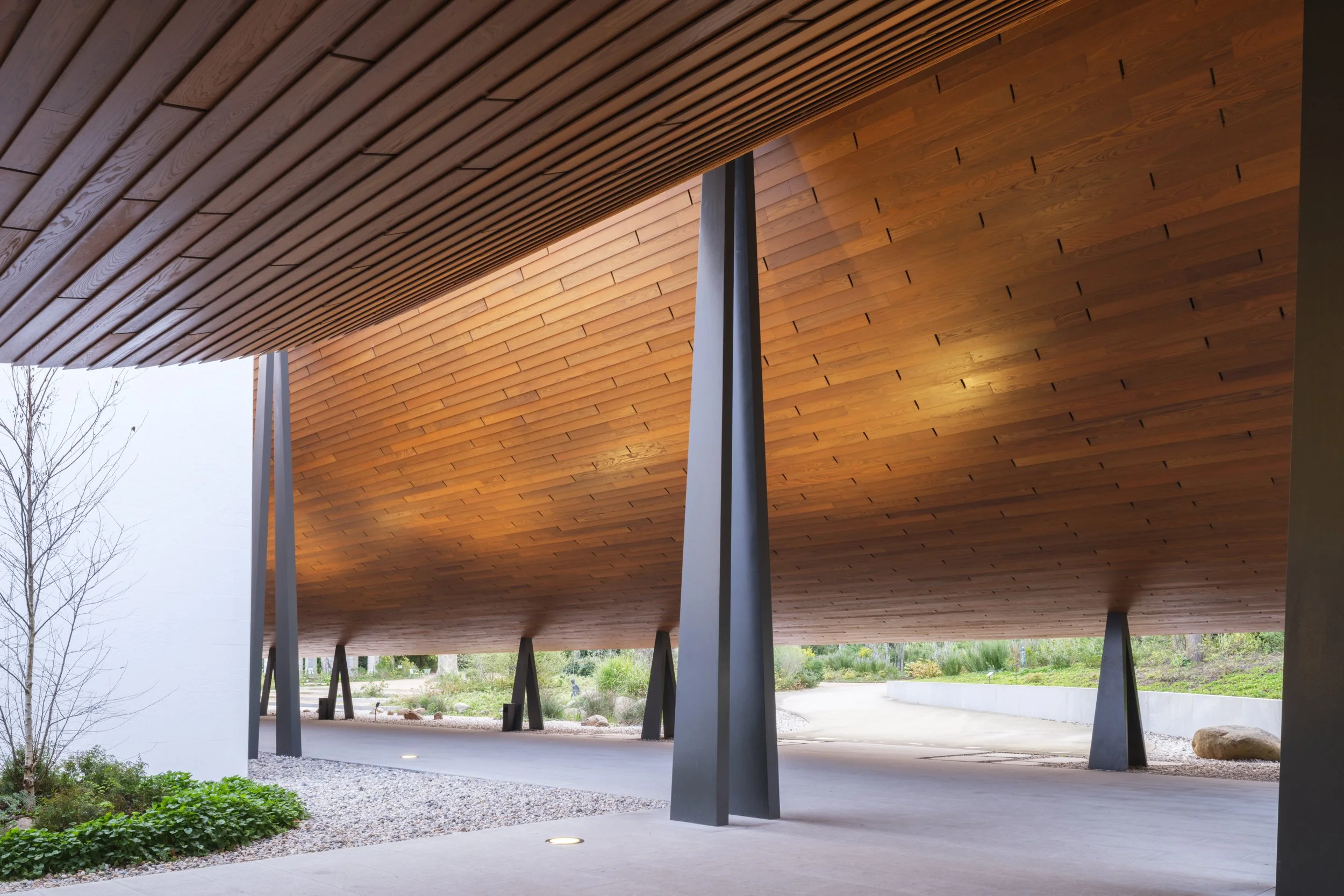
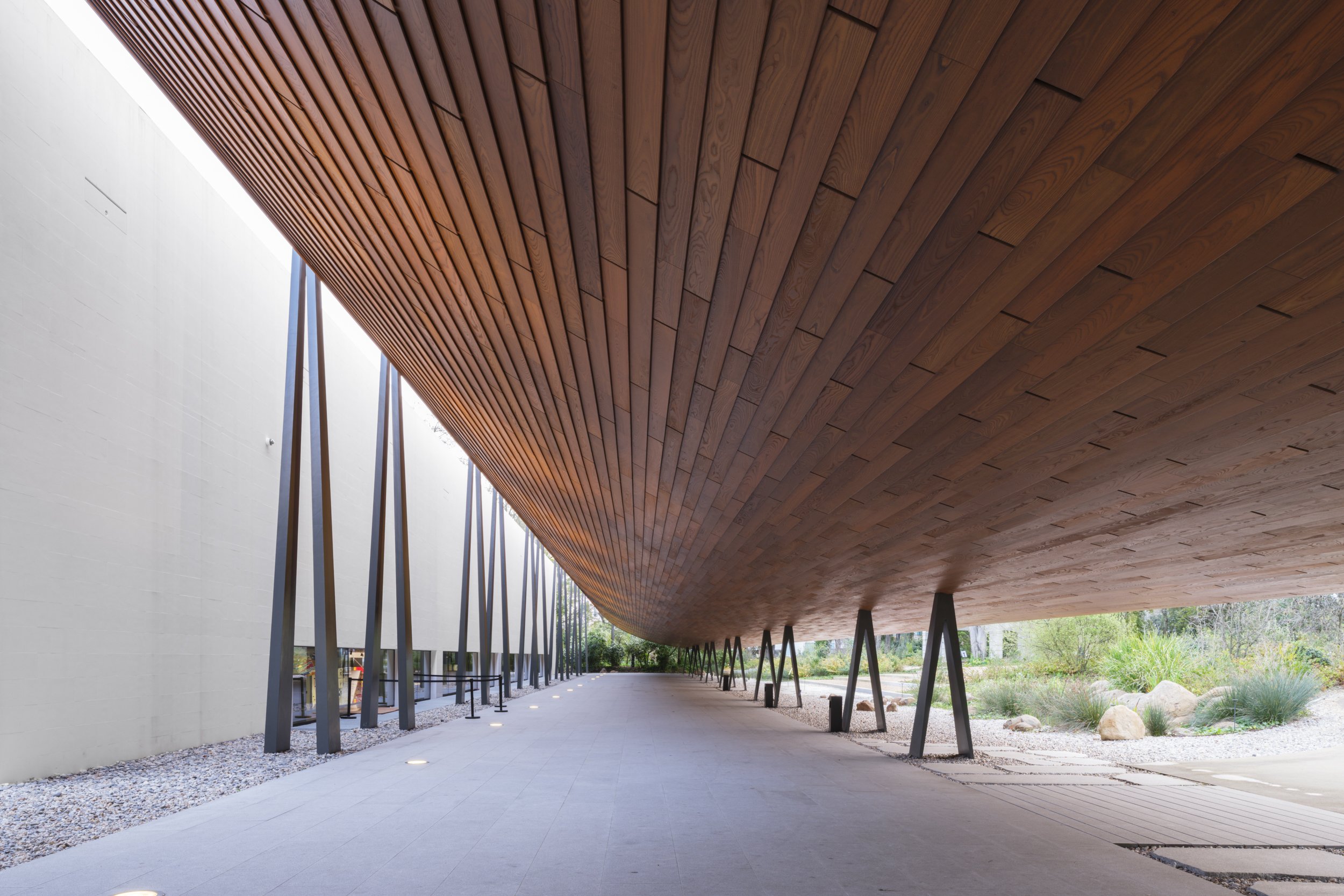
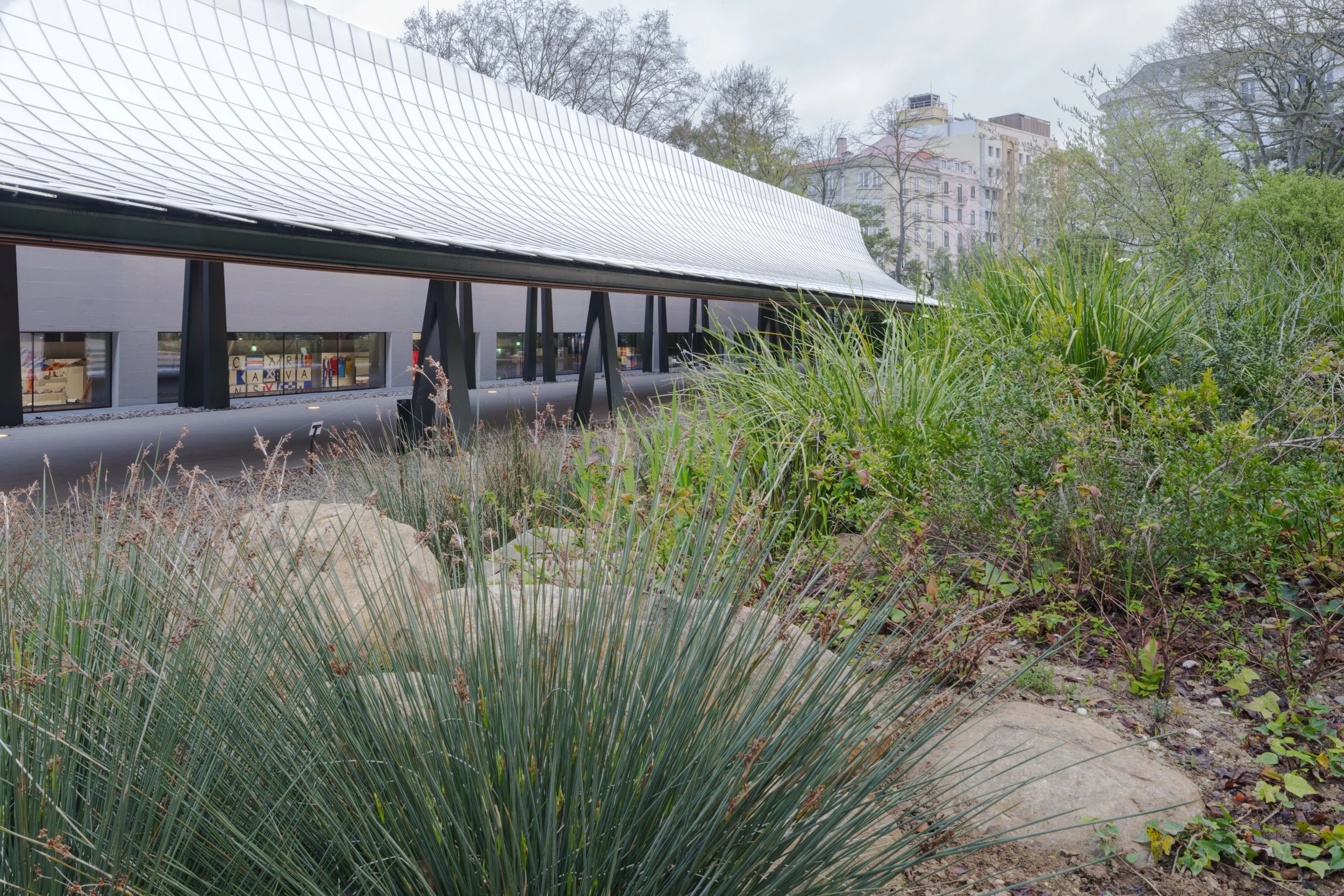
The underside of the canopy is lined with Portuguese ash wood tiles, arranged in a grid that creates a rhythm as you walk. The top surface, the rain-facing side, is clad in Portuguese ceramic tiles. The same material tradition, the same regional craft, as the building on the banks of the Tagus forty minutes away.
I stood under the canopy on a Thursday morning with early woodland light filtering through from the garden, and it took me a moment to place the connection. Two of the most significant architects working in Europe today, on two entirely different buildings in the same city, and both reached for Portuguese ceramic as their material of choice. That's not a coincidence. That's a conversation.
The Photographic Challenge: Woodland and Dappled Light
Where MAAT asks you to fight overexposure, all that white ceramic reflecting river light and open sky simultaneously, CAM Gulbenkian asks you to wait for gaps and thoroughly understand exposure. The woodland canopy creates a microclimate that's constantly shifting. Deep shadow under the Engawa, bright sky above, directional shafts of light pushing through the trees at unpredictable angles, as well as spotlights creating hotspots on the wood.
The shots I was after, demonstrating the sheer magnitude of the canopy and the interconnectivity between outside and in, required patience… They came, eventually. Getting to CAM Gulbenkian just as the public access gates to the parkland were opened (sunrise, closed at sunset), I did have to wait for my shots as, being public access, people regularly use the space to walk through.
That's always the lesson, isn't it. The building rewards the patient photographer.
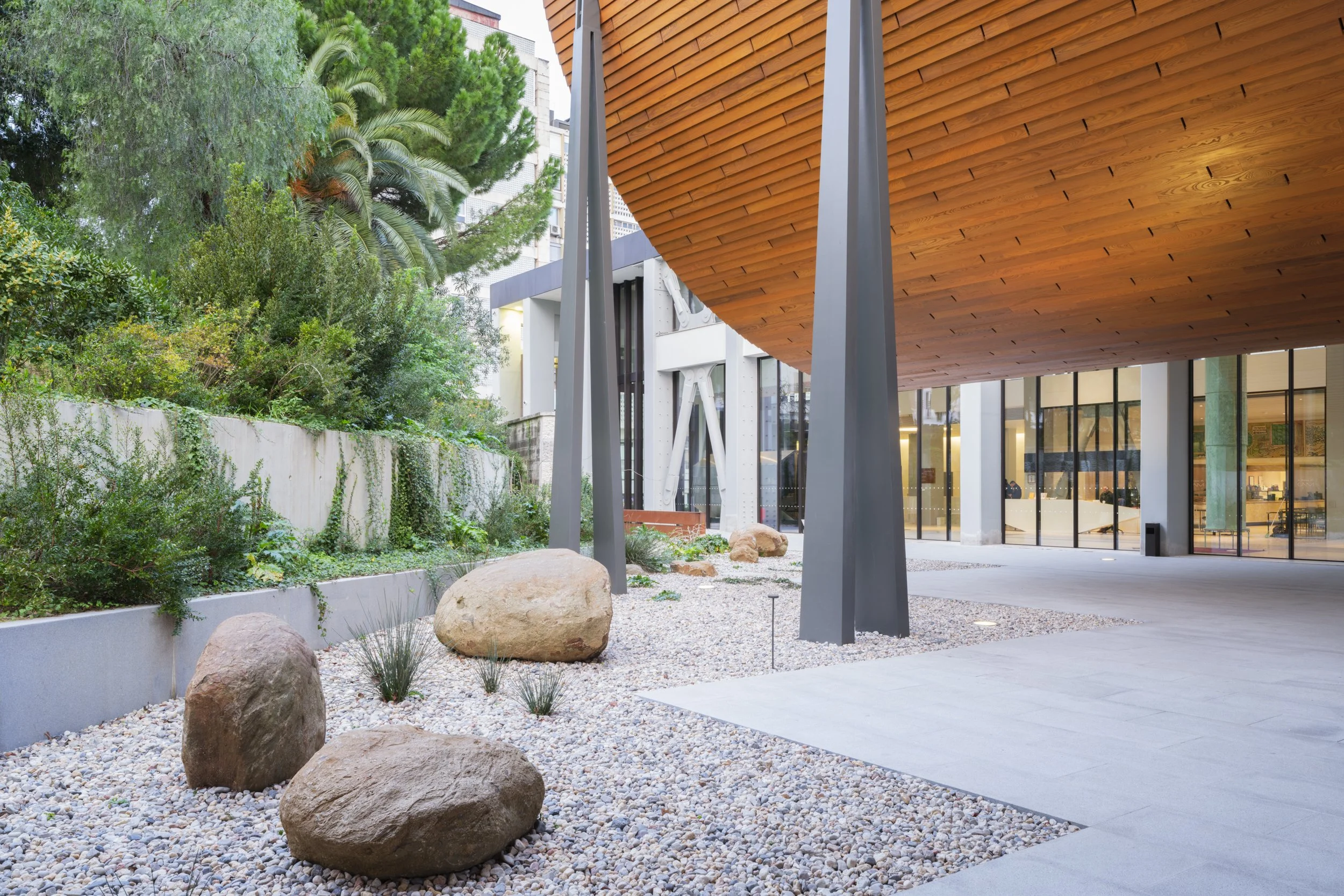
Spotlights highlight the warmth and grain of the Portuguese Ash on the underside of the Engawa at CAM Gulbenkian
The lower gallery, which extends partly below ground level into the garden slope, offers something else entirely: windows looking upward into the woodland. Dappled light. Leaf movement. The inside of the building and the outside of the garden in the same frame. I spent longer down there than I’d planned, which is usually the sign that something is working.
Two Buildings, One City, One Week
I've been asked since returning whether I have a preference between the two. It's the wrong question, and I've said so.
MAAT and CAM Gulbenkian aren't in competition. They're asking different questions. Levete's building asks what a museum can be — whether architecture can be simultaneously civic object, working institution, and public landscape. The answer, ten years in, is an unambiguous yes.
Kuma's building asks something quieter. Whether architecture can listen, to its garden, to its city, to its material history, rather than speak. The answer, if you're willing to slow down long enough to hear it, is equally yes.
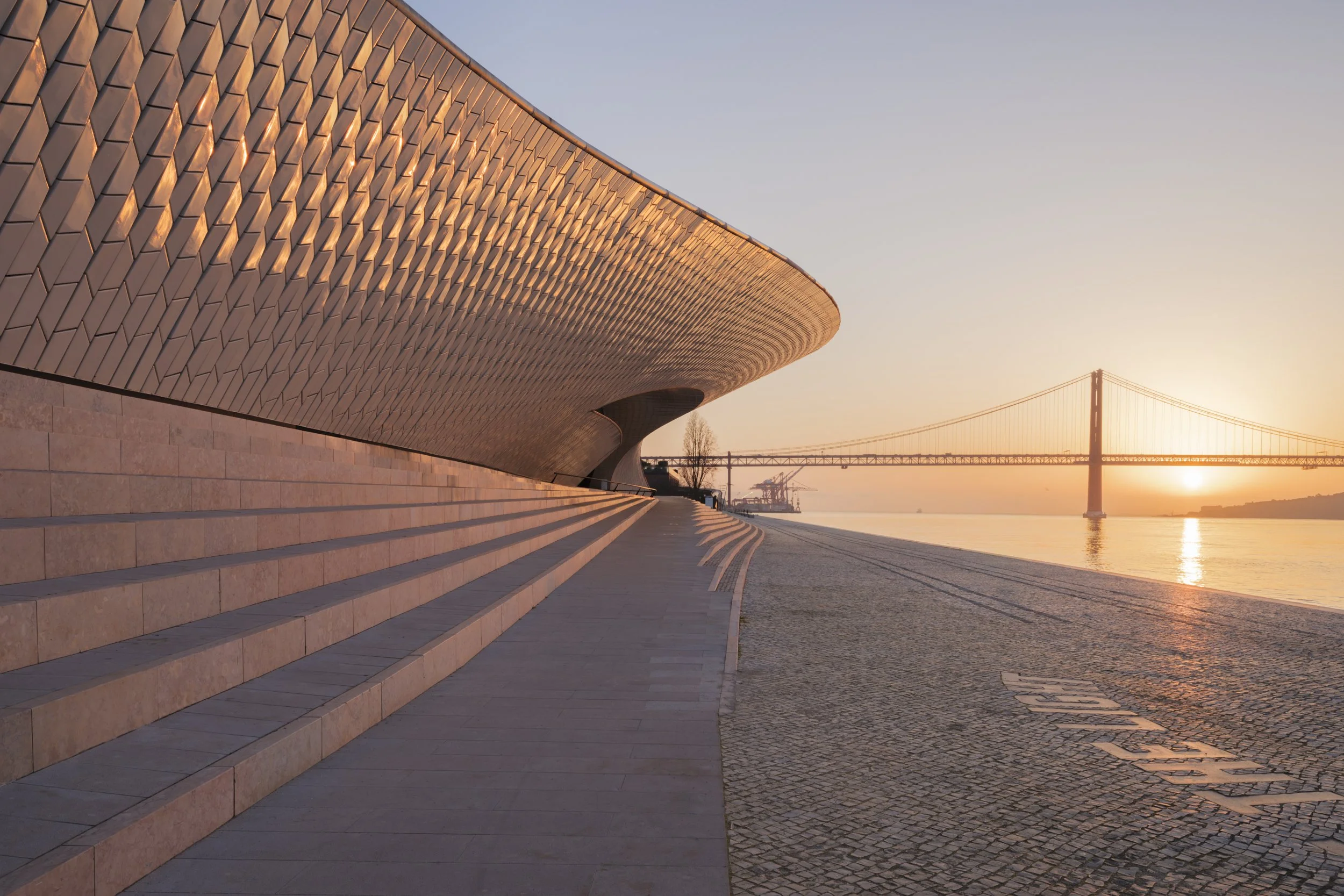
First light bathes the ceramic tiles of MAAT in a copper glow
The tiles connect them. Not as a stylistic coincidence but as a genuine dialogue — two architects from different traditions, working at different scales, reaching independently for the same regional craft as the means of rooting their buildings in place. If you want to understand what contemporary architecture at its best can do, Lisbon in 2026 is where you should be pointing your camera.
I'll be back. The light changes every hour and there are photographs I didn't get. That, too, is part of this work — knowing which shots are still out there waiting.
Practical Information
MAAT — Museum of Art, Architecture and Technology
Avenida de Brasília, 1300-598 Lisbon, Portugal
Open: Wednesday to Monday, 11:00–19:00 (closed Tuesdays)
The rooftop walkway is freely accessible
Best light: early morning for the facade texture; dusk for the river reflection
Note: no straight lines means levelling discipline is essential — use your tripod's bubble and in-camera horizon
Website: maat.pt
CAM Gulbenkian — Centro de Arte Moderna
Rua Dr. Nicolau de Bettencourt, 1050-078 Lisbon, Portugal
Open: Tuesday to Sunday, 10:00–18:00 (closed Mondays)
The Engawa canopy and garden are accessible during daylight hours
Best light: early morning on a clear day
Allow time to walk the full canopy length — the shift from low to high is the architectural experience
Website: gulbenkian.pt/cam
If this kind of work speaks to you — architectural photography that goes beyond the record shot and tries to find the story in a building — I’d love to hear from you. My portfolio is here, and you can find me on LinkedIn. I’m always interested in conversations with architects, developers, and institutions who want their work seen properly.
One Arm 💪 One Camera 📷 One World 🌍